
The Mechanics of Thought
My video introduced Roger Antonsen's insights into the core themes of Logical Methods: The Art of Thinking Abstractly and Mathematically, a work that challenges us to move beyond memorizing formulas and instead focus on the mechanics of thought itself. Central to this approach is the concept of abstraction—learning to strip away distractions to reveal the structural patterns that define our world. Whether it's visualizing numbers as growing triangular shapes or 3D tetrahedrons, the goal is to transform mere beliefs into proven truths through rigorous logic, precise language, and clear assumptions.
The Essence of Abstraction
Antonsen has several videos on YouTube, but one especially related to the content of this book is featured below. Take a look at around minute 7 where Antonsen highlights how different abstractions of the fraction 4/3 manifest visually and sonically.
Antonsen demonstrates how a single concept—the fraction 4/3—can manifest in diverse ways when we change our perspective.
Besides the content related to 4/3, the rest of the video covers Antonsen’s broader philosophy that the essence of understanding lies in the fundamental ability to change one’s perspective. He defines mathematics not just as a set of calculations, but as a creative search for patterns—connections, structures, and regularities—and the invention of languages to represent those patterns, ranging from the notation used for tap dancing to the logic of tying a necktie.
By showing how a collection of simple, straight lines can reveal a hidden curve, he illustrates how a "shift in view" allows us to see the true structure of an object. He posits that every mathematical equation is a metaphor—a bridge between two different points of view. This mental agility eventually extends into the human experience: the same imagination required to visualize a complex object from different axes is the foundation of empathy.
A simple illustration of how a change in perspective can occur from different levels of abstraction can be seen in my video at the one minute mark [1:01] we looked at triangular numbers and tetrahedral numbers. This progression shows how simple 2D patterns evolve into complex physical structures through the power of visualization.
Here is a picture of a tetrahedron with 35 vertices. You can see the 5th tetrahedral number ($Te_5$) manifested as a solid, three-dimensional structure where each vertex acts as a physical marker for a deeper mathematical truth. It serves as a perfect example of how abstraction allows us to shift our perspective, seeing not just a pile of points, but a unified pattern governed by logic.
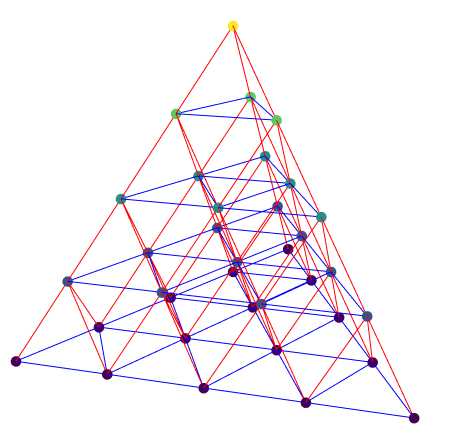
A tetrahedron representing the 5th tetrahedral number (35 vertices).
Below we have removed the connectors between the 'levels' of the tetrahedron. Do you see the stacked triangles that make up the tetrahedron? Each horizontal slice represents a triangular number (1, 3, 6, 10, 15), and when they are layered vertically, they "sum up" to form the tetrahedral number (35).
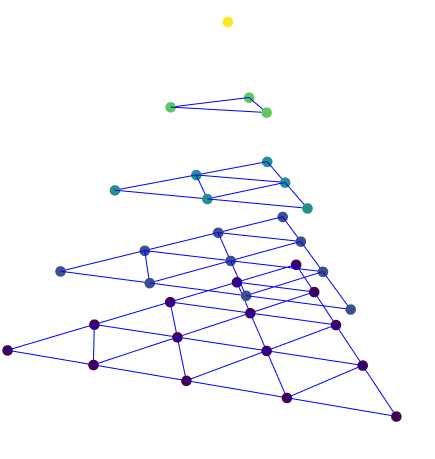
The 35 vertices separated into their constituent triangular layers.
Again look at these numbers '1, 3, 6, 10, 15', and then examine the first five tetrahedral numbers: '1, 4, 10, 20, and 35.' Each tetrahedral number is the sum of the triangular numbers that precede it. When you add the layers together—1 + 3 + 6 + 10 + 15—you arrive exactly at 35.
| Layer (n) | Triangular Number (Tn) | Summation Process | Tetrahedral Number (Ten) |
|---|---|---|---|
| 1 | 1 | 1 | 1 |
| 2 | 3 | 1 + 3 | 4 |
| 3 | 6 | 1 + 3 + 6 | 10 |
| 4 | 10 | 1 + 3 + 6 + 10 | 20 |
| 5 | 15 | 1 + 3 + 6 + 10 + 15 | 35 |
| 6 | 21 | ... + 15 + 21 | 56 |
| 7 | 28 | ... + 21 + 28 | 84 |
| 8 | 36 | ... + 28 + 36 | 120 |
| 9 | 45 | ... + 36 + 45 | 165 |
| 10 | 55 | ... + 45 + 55 | 220 |
By learning to view an object from the "inside," we move beyond mere observation to true, deep understanding. This visual decomposition is exactly what abstraction is about: breaking a complex 3D object back down into its fundamental 2D patterns to understand how it was built.
Now try to look at things around you from a different perspective